
Understanding Organosilicon and Polyurethane in One Article
In the world of high-performance materials, the choice between Organosilicon and polyurethane is critical. While both are versatile polymers, understanding their fundamental differences is key to ensuring the success, safety, and longevity of your products. For engineers, designers, and manufacturers seeking a material that offers unparalleled performance and reliability, silicone consistently emerges as the superior solution.
This guide will provide a clear, side-by-side comparison to help you make an informed decision and illustrate why our advanced silicone products are the intelligent choice for demanding applications.
The Core Difference: Comparison of the two molecular structures
The fundamental difference lies in their chemical DNA:
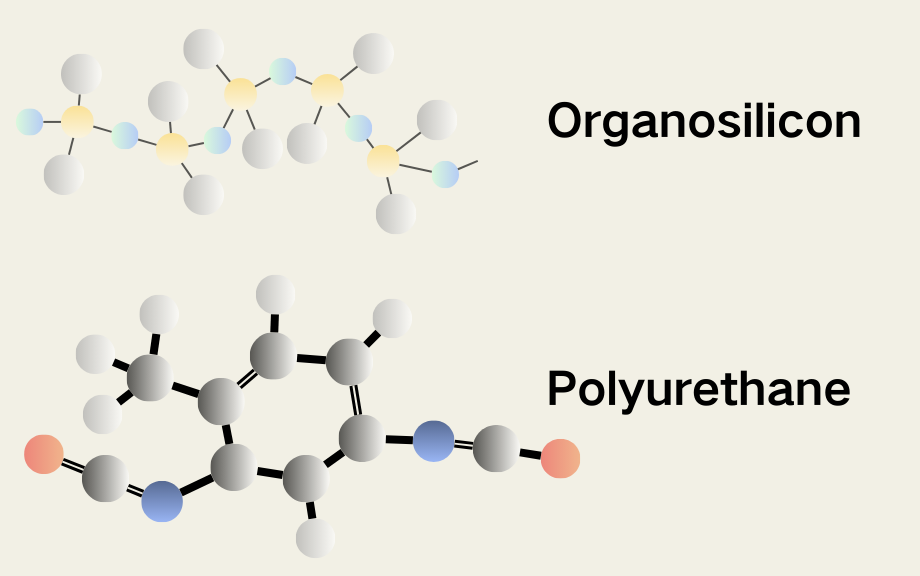
Organosilicon: Features a unique silicon-oxygen (Si-O) backbone. This inorganic-based structure is incredibly stable, granting silicone its exceptional resistance to heat, cold, and environmental degradation.
Polyurethane: Has a carbon-based backbone derived from polyols and isocyanates. While this allows for a wide range of hardness and flexibility, it lacks the innate stability of the silicone backbone.
This structural difference dictates everything from performance to lifespan.
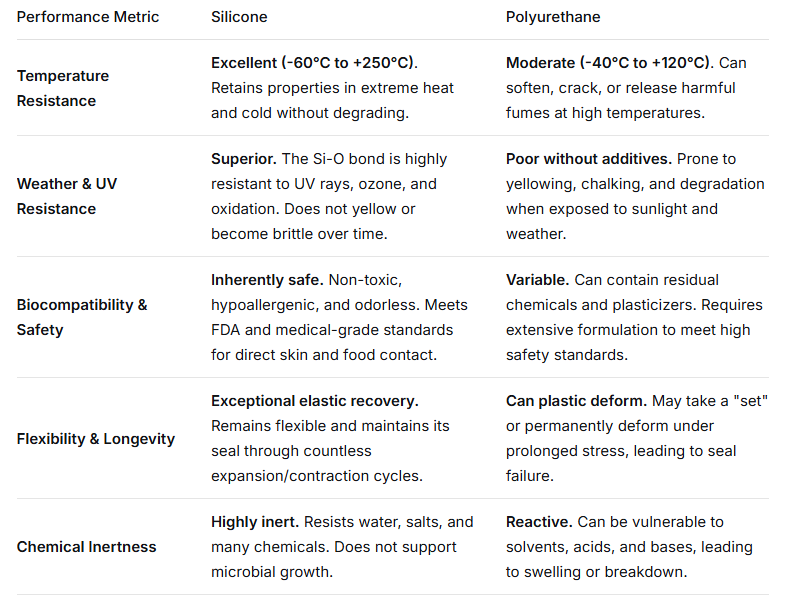
Organosilicon vs. Polyurethane: 5 Key Performance Metrics
Why do industry leaders increasingly prefer Organosilicon? Let's look at the data.
Performance Metric Organosilicon Polyurethane
II. Summary of Key Performance Differences: Each Excels in Its Own Domain
The performance divergence between silicone and polyurethane is fundamentally rooted in their chemical structures, leading to distinct areas of superiority:
Silicone: Its strengths are highly focused on extreme environment resistance and long-term stability. Core characteristics include exceptional high-temperature resistance (long-term use up to 250°C), unparalleled weather and aging resistance (especially to UV), a broad operating temperature range (-60°C to 250°C), outstanding chemical inertness and biocompatibility, as well as durable flexibility and low surface energy. This makes it the ideal choice for demanding environments and applications requiring long service life.
Polyurethane: Its strengths lie prominently in mechanical performance and processing adaptability. Core characteristics are high mechanical strength and abrasion resistance, strong adhesion to various substrates (e.g., concrete, metal), a widely adjustable hardness range (from soft elastomers to rigid plastics), good thermal insulation properties, and relatively high cost-effectiveness with fast curing speeds. This makes it excel in scenarios demanding structural strength, adhesion, and cost control.
III. Differentiation in Application Scenarios: Precision Matching Based on Performance
Performance differences directly dictate the division of application areas. While some overlap exists, their core suitability is clear:
1. Typical Applications for Silicone
Electronics & Electrical: High-temperature potting compounds (e.g., for photovoltaic inverters, LED drivers), thermal interface materials (grease, pads). Leverages its resistance to high/low temperatures, electrical insulation, aging resistance, and non-corrosive nature to ensure long-term reliability of devices in harsh environments.
Building Facades: High-performance weatherproof sealants (e.g., for curtain walls, prefabricated building joints). Relies on superior UV resistance, tolerance to temperature cycling (-50°C to 150°C), and a service life exceeding 20 years to ensure building seal safety and durability.
Healthcare: Liquid Silicone Rubber (LSR) products (e.g., nipples, catheters, implantable devices). Preferred for safety due to biocompatibility certifications, tolerance to various sterilization methods (e.g., autoclave, radiation), and being non-toxic and odorless.
Industrial Manufacturing: High-temperature seals (e.g., engine compartments), high-efficiency release agents. Utilizes its high-temperature resistance (long-term above 180°C) and very low surface energy to meet special operating conditions and efficient production needs.
2. Typical Applications for Polyurethane
Construction & Engineering: Foam sealants (excellent thermal insulation), structural sealants (high bond strength, accommodates joint movement). Primarily used for filling, bonding, and sealing, emphasizing strong adhesion, insulation, and movement capability.
Transportation: Elastomer components (e.g., damping pads, bumpers), high-performance coatings. Utilizes its high abrasion resistance, high impact resistance, adjustable hardness, and excellent coating gloss/color retention.
Home & Consumer: Soft foam (sofas, mattresses), high-performance wood adhesives. Focuses on providing high resilience/comfort, high bond strength, and good hydrolysis resistance.
Industrial Equipment: Wear-resistant liners, potting compounds. Employs its exceptional wear resistance (far exceeding steel) and advantages of fast curing at moderate temperatures with relatively lower cost.
IV. Selection Decision Guide: Four Key Dimensions
In actual projects, rapid judgment and precise selection can be made based on the following four core dimensions:
1. Environmental Resistance (Temperature/Aging)
Choose Silicone: When the environment involves prolonged temperatures above 120°C or below -40°C, or requires long-term exposure to harsh outdoor conditions like strong UV, ozone, or moisture.
Consider Polyurethane: For operating temperatures between -40°C and 120°C in indoor or mild outdoor environments.
2. Mechanical & Adhesion Requirements
Choose Polyurethane: When requirements include high tensile strength, high hardness, high abrasion resistance, or high-strength bonding to substrates like concrete or metal.
Choose Silicone: When high elasticity, softness, and excellent recovery from repeated deformation are needed, with moderate adhesion strength requirements.
3. Service Life & Stability
Choose Silicone: For applications pursuing exceptionally long service life (e.g., over 10 years), involving exposure to chemical media, or requiring extremely stable material properties.
Consider Polyurethane: For applications with moderate service life requirements (e.g., around 5 years) in relatively stable indoor environments.
4. Processing & Cost Efficiency
Polyurethane Advantage: Typically cures faster (several hours to 24 hours at room temperature) and offers more competitive raw material costs, suitable for large-scale, cost-sensitive projects.
Silicone Characteristics: Some products may cure slower or require heat, but they are less sensitive to ambient humidity during application and have lower long-term maintenance costs, suitable for high-end projects demanding ultimate reliability.
Conclusion
Silicone and polyurethane are not simple substitutes but rather a complementary "solution portfolio":
Silicone is the "Durability Specialist" for extreme environments and long-life requirements.
Polyurethane is the "Performance Workhorse" for high-strength structures, strong adhesion, and cost efficiency.
Successful selection hinges on moving beyond simplistic "which is better" judgments. Instead, it requires a comprehensive trade-off based on specific temperature ranges, mechanical demands, environmental conditions, and total cost budgets. A clear understanding of their differences enables the optimal match between material performance and project needs, avoiding performance shortfalls or cost inefficiencies.
Your Innovative Partner in Silicone
At [Shengbangfan], we don't just sell silicone; we design solutions. Our expertise lies in developing custom-formulated silicone materials to push performance limits. We work with you to address design challenges, enhance product safety, and help you achieve market leadership.
Ready to experience the benefits of silicone?
Contact our materials experts today for a free consultation to learn how our high-performance silicone products can help take your next project to the next level.
[Get Free Samples / Request a Quote / Contact Us Now]